Promaja! (Also Know as “A Mighty Wind”)

I’ve written about promaja (pruh-MOY-uh) previously. Of all the cultural differences I have experienced, I still find this to be one of the more perplexing. (Although there are others that come close. Anyone care for spaghetti with ketchup sauce? :-P)

In case you didn’t know, “promaja” refers to cross-breezes. Apparently, they are very dangerous here in the Balkans.

I first learned of promaja while riding in a taxi with my two sitemates and my language teacher. It was 95 degrees out, and our taxi driver had the windows rolled up (also note: there was no air conditioning in the taxi). I thought the taxi driver was 1) oblivious to the heat or 2) just being a jerk. But then my language teacher told us about promaja (mind BLOWN!). I had never heard of such a thing.

This story has come to illustrate something important to me: Sometimes, people do things, and they might not be doing those things for the reasons I think (or reasons I know).

Still, that doesn’t mean I believe in promaja. 🙂

Promaja GIFs.jpg

Happy Halloween! 🙂

Guest Blogger: Ingrid Lantz (Hiking in Valbonë, Albania)

Hi, guys! My friend Ingrid has gone on some very cool hikes, and I asked if she would write about her experiences for this blog. Read on to learn about her recent hike in Valbonë, Albania. All of these beautiful pictures were taken by Ingrid. –April

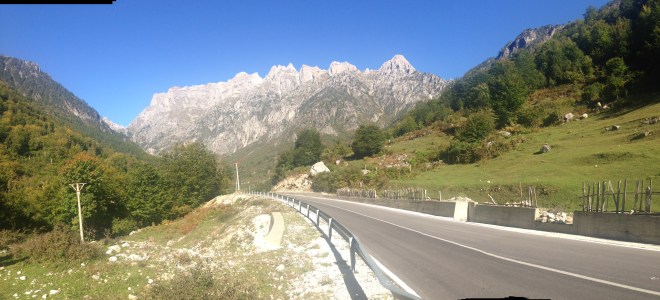
hiking-valbone-albania-1
Photo by Ingrid Lantz

Since I’m from a state known for its mountains, I’ve been longing to see and experience the mountains of Kosovo and beyond since I arrived. In my 4 months here, I’d yet to see much of the wild parts of Kosovo, so a trip to Valbonë National Park sounded great. Even though I live near Prizren, which is in the south of Kosovo and near the mountains or right up next to them, it’s often difficult for me to get to any hiking. As a Peace Corps volunteer we’re not allowed to drive, and shuttles or local hiking buddies can be difficult to find. This trip was a charter trip with a tourist company called Eurotrip to Northern Albania … and while that’s not technically Kosovo, it’s just two hours northwest and over the border in a country that shares a common language and heritage with Kosovo. In fact, Kosovars are so linked to Albania that most of the time they use the Albanian flag at celebrations and not the Kosovar flag.

Leaving from Prizren early in the morning we headed northwest towards the market town of Gjakovë. Just after the city, as we traveled directly west over the border. You could see the craggy peaks of the Albanian Alps in the distance. They looked imposing. Another name for them is the Accursed Mountains. This part of Albania is known for it’s rugged isolation, both of the environment and its native people, and until recently, few outsiders ventured there. Now it’s one of the gateways to the Peaks of the Balkans trail, where you can hire a guide traverse these pristine mountains through the countries of Kosovo, Albania and Montenegro.

As we wound our way up the narrow valley road that hugged the river between towering peaks, I gained abundant respect for the driver as he negotiated hairpin turns and one-lane bridges. Along the way fall colors erupted from trees sprinkled among the evergreens. We slowed often for cows and herds of shaggy longhaired goats. Most perplexing to me was the goatherder sporting a full suit but with a hobo bag on his back. Small villages dotted the landscape in the lower valley, hay stacked in formations that looked like giant beehives.

Our bus dropped us off literally at the end of the road into the park at Hotel Burimi I Valbones, a lovely and large hotel with a restaurant and most importantly, a bathroom! Which, of course, they graciously allowed all 60 or so of us to use. From the hotel the trail strikes out across a deep, wide glaciated valley. This part of the trail is along a very rocky blindingly white stony glacial moraine and goes for about 3 miles. Sturdy shoes with good soles are recommended. Even though it was October, the exposure and the rocky trail gave me a good feeling for what it would be like in the height of summer. It was hot. A backpacker couple told me later that the mountains don’t have much water and are extremely hot and dry in the summer. Even in October, they still carried water for overnight backpacking.

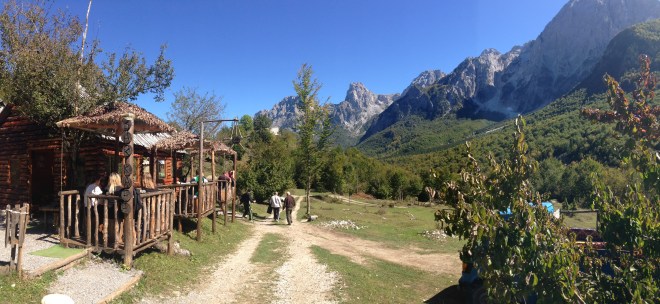
Along the valley are some abandoned old stone houses that looked interesting to explore. Towering peaks on both sides and ahead reminded me of the stony craggy peaks of California’s Sierra Nevada range. About 3 miles in we came upon a fully functional restaurant, bar and guesthouse. They served traditional Albanian food, salad, buke (bread), fried peppers, cheese and meats. This was at the end of the 4-wheel drive tourist road that some took instead of walking. The sweeping view from this restaurant allowed you to see for miles down the valley. Directly in front of the restaurant, across the valley, the mountain rose up like a great wall several thousand feet up. The granite tops looked white, and at first I thought it must be snow, but then I realized the rocks on top were streaked white.

hiking-valbone-albania-3
Photo by Ingrid Lantz

After this restaurant the trail narrowed and was not accessible by vehicle. About a mile after there was another small café and as I passed by a woman was in the process of making flia, a very traditional Albanian dish that consists of multiple crepe-like layers brushed with cream, oil and flour. It looked like it would be ready on my way back. She smiled as I asked if I could take her picture.

hiking-valbone-albania-2
Photo by Ingrid Lantz

After that, I followed the trail steadily upward through forest and deeper into the canyon. In a couple miles we began to climb steeply and then for the last 30 minutes we clambered over tree roots and stones to our final destination, a waterfall.

As we savored the cool spray, some ate and splashed in the water. One devout hiker laid out his prayer rug on a flat rock at the bottom of the falls and pointed downvalley – apparently the same direction as Mecca – and with a view that went for miles, began to pray.

TEFL: Activities Using Little to No Resources

One of the more challenging aspects of teaching in Kosovo is working with few resources. We have chalkboards/chalk and (some) textbooks (half of my classes don’t have books yet … and school started a month ago). That’s pretty much it. The Peace Corps wants us to develop sustainable new ideas for the classroom. Even if I could afford to buy extra materials, that really isn’t fair to the other teachers, who might not be able to do so.

I’ve mentioned previously that this is my first experience teaching in a classroom. I’ve been scouring the Internet for ideas for classroom activities. Printouts are a challenge. My school has one printer, and it isn’t even an industrial-sized one you see in offices across the U.S. It’s closer to the size you might have in your home office. So, printing out materials for dozens of students every day isn’t really an option.

I’ve rounded up some of the best activities I’ve found so far that require few to no resources. I’ll likely continue to add posts like these to the blog as I discover/come up with more ideas. There are a million “icebreaker” games out there, but I’ve focused on educational activities where students have to speak or write in English.

Teaching Present Continuous
1. One student comes up to the front of the classroom and acts out a daily activity.
2. The other students have to call out what he/she is doing. “He is brushing his teeth.” “He is washing the dishes.”

Hangman (for use with any vocab words)
1. Allow students to take turns acting as the “hangman,” choosing words and calling on their classmates to guess.

Teaching Parts of the Body
1. Sing “Head, Shoulders, Knees and Toes.”
2. Draw a body on the chalkboard and have students come up to label parts

A Tree Map (used to teach are/can/have)
Draw something that looks like this on the board:
————
|             |           |
Are       Can     Have

And ask students to help you fill in the tree. Example: Spiders
“Spiders are hairy.” “Spiders can jump.” “Spiders have eight legs.”

Prepositions
1. Describe a room and have students draw what they hear
“There is a coffee table in the middle of the room. On the table is … Under the table is …Beside the table is … ”

Stand Up If …
1. Have students make a circle with their chairs. Remove one of the chairs.
2. Have a student volunteer stand in the middle of the circle.
3. The student volunteer has to come up with a sentence, such as, “Stand up if you’re wearing a white shirt.”
4. All the students wearing a white shirt must stand and try to find a different chair, while the person in the middle also tries to find a chair.
5. The last person standing has to come up with the next sentence.

**I compiled these into a downloadable PDF: tefl-esl-activities-using-little-or-no-resources.

If anyone out there has other ideas, please feel free to share!

Questions About Schools in Kosovo

My friend Dana loves it when she makes “guest appearances” on this blog. (Hi, Dana!) She recently emailed me a bunch of questions about school. I thought about making a video to answer them, but I am lazy so, no.

What ages are they again?
I teach 7th and 8th grade, so they are eleven to … fourteen?

Is it just you and the kiddos all day? Is there anyone else in the classroom with you?
No, I am not supposed to ever be alone in the classroom. I am partnered with a Kosovar co-teacher. The goal of Peace Corps is to help teachers here develop new methods of teaching, and to develop sustainable teaching materials.

How long do you have each class?
40 minutes

How many classes a day do you teach?
It varies … 3-5 classes per day. Peace Corps Volunteers are expected to teach 20 classes per week.

What time does school start and end?
Most schools in Kosovo operate on two shifts, morning and afternoon. I work mornings, so 8:00-1:00. I think the afternoon shift starts at 1:00 and goes to 4 or 5:00.

What’s all the rage on the playground?
Because the school day is short, I haven’t observed an official recess time.

Are they soccer kids?
Totally. Volleyball is also a popular sport here.

What’s the big activity for them?
I don’t know.

What gets them excited?
They seem to be into all of the things American kids are into. One of my students has a cool Spiderman/Batman pencil case. Another student has an adorable Hello Kitty backpack I want to steal. (Of course, I am kidding. I would never steal from a child. Maybe.)

What are the other classes most of your students are taking?
The basics … Shqip (Albanian), English, math, geometry, physics, geography, history, physical education …

Are they led down a vocational route, or a route to higher education?
Both. My understanding is that kids take a test at some point. Depending on how they score, some are sent to vocational school, while others apply to college.

What is the school structure? Is there a principal? Who do you report to?
I report to the school director, who I believe reports directly to the Ministry of Education. (Side note, I love that name. It reminds me of the Ministry of Magic in Harry Potter.)

How many grades are there?
All of them. 🙂

Do the older kids have after school jobs?
I don’t think so. Employment here is scarce for adults. I don’t think most children work.

Are there any sort of extra curricular activities?
If you’re talking like a drama club or something, not that I’ve seen. Some volunteers run programs like English Clubs, etc. There’s also a new poetry competition that’s starting up, and a push to start chess clubs in schools.

school-kosovo

Thanks for your questions, Dana!

A Family Distinction

When I re-connected with my counterpart a few weeks ago, after not having seen him since our first meeting, he asked me how many words in Shqip I know. I said, “120?” It was a guess. In truth, I have no idea how many Shqip words I know at this point. I continue to plod along, attempting to practice with my flashcards and dictionary.

When it comes to family vocabulary, one of the things I find most interesting (and is that different from English) is the distinction in your parents’ siblings. Your father’s sister is your teze, while your mother’s sister is your hallë. Your father’s brother is your axhë, while your mother’s brother is your dajë. I was having a conversation with my temporary host brother about this, and he was baffled by the English language’s simplistic “uncle” and “aunt.”

“But how do I know if you’re speaking about your father’s brother, or your mother’s brother?” he wanted to know. And I was like, who cares? Either way, their relationship to me is the same.

What’s even more interesting about Shqip is that there is no distinction between grandson/nephew (nipi), or granddaughter/niece (mbesë ). Also, the word for daughter (vajzë ) is the same as the word for girl. Likewise, the word for son (djalë) is the same as the word for boy. To me, these would be a far more important distinctions to make than which aunt or which uncle I am speaking about. (But oh well. I didn’t invent the language.)

Also, the word for son/boy (djalë) is very similar in sound to the word for devil (djall). I’m told Americans regularly screw this up. Oops.

Guest Blogger: Valeriana Dema

Hi, everyone! My friend Val graciously agreed to write today’s guest post, where she shares her unique experience as a Peace Corps Volunteer. –April

IMG_2870
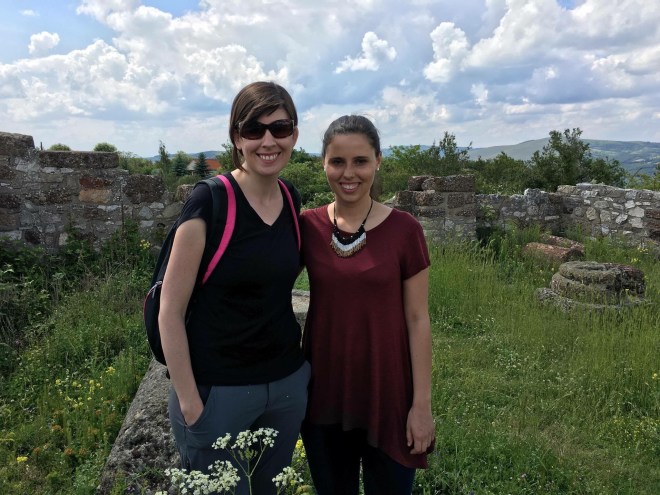
April and Val at Novo Brdo

Thank you April for asking me to write a post which helped me reflect on my time in Kosovo. I’m very happy to contribute in a small way to April’s wonderful blog 🙂

The other day my host sister said to me in Albanian, “You are the border” — “Ti je kufi.” She was talking about the split in generations in my Albanian-American family, and how I was in between the two generations. For example, most of my older family members speak Albanian fluently, while many in the younger generation are losing the language. My language skills place me somewhere in between those two generations, and like a lot of children of immigrants, I’ve always felt in between two cultures, but not fully accepted by either. However, in many ways volunteering with Peace Corps Kosovo has helped alleviate that feeling for me.

The past couple months of having a group of Americans experiencing all the joys and maladies of Albanian culture along with me has been a wonderful experience. Being in between cultures can be alienating, so it felt very acknowledging that a bunch of my new friends, who had been immersed in Kosovar culture and living with Albanian host families, understood how both the warm love as well as the tight grip of a close-knit Albanian family feels. It also was really meaningful for me to make connections with Kosovar natives and hear their perspectives on issues and their stories and struggles. As an American, who in many ways has a comfortable life, I’ve had a hard time even imagining what my parents’ and my grandparents’ lives were like. So spending time in Kosovo and with Kosovars helps bridge that gap, helping me understand and making me feel closer to my own family.

Yet being an American volunteer in Kosovo also strengthens the feeling of being at the border. I’m in very close proximity to two different cultures, but I’ll never really know what’s it’s like to have grown up in this part of the world, and I’ll always have different experiences than an American whose family has been there for generations. Part of my experience in the Peace Corps has been accepting that I’ll probably always feel a little bit in between. In the Balkans, borders are constantly being disputed, controlled by foreign powers, cut, and renamed. Being at the border makes me vulnerable and self-conscious, always trying to define myself and defend attacks from both sides. But I’ve also realized the border is a blessing because I have a unique view of both sides.

Shumë Speca!

You know that old saying, “You are what you eat.” If that is true, I am a pepper.

The Albanian word for peppers is “speca” (I pronounce it  SPAYT-SA, and to me, it sounds like others pronounce it this way, to. [Even though there is no “t.”]). I hear “speca” so often that in complete honesty, I sometimes have trouble remembering the English word for it.

I like speca, but over this past summer I have eaten enough to grow tired of it. But, I thought, Ah-ha! Autumn is coming. And that means no more speca.

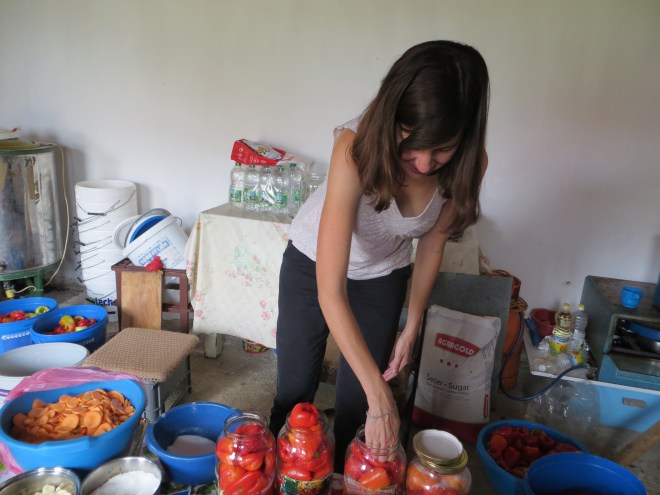
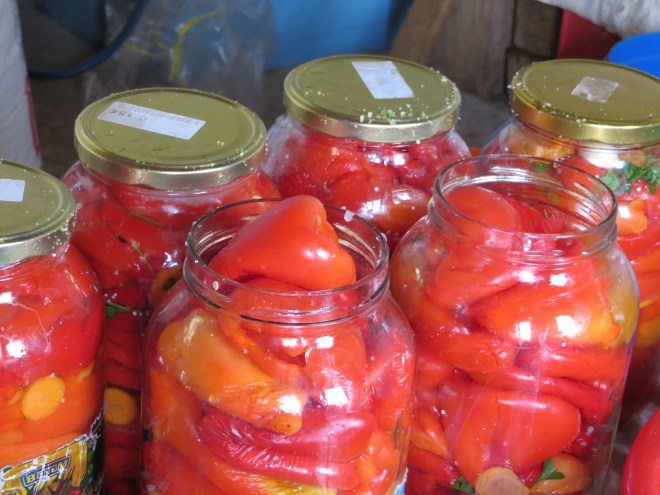
I thought wrong. I forgot about canning. It seems I will be enjoying speca for months (and years) to come!

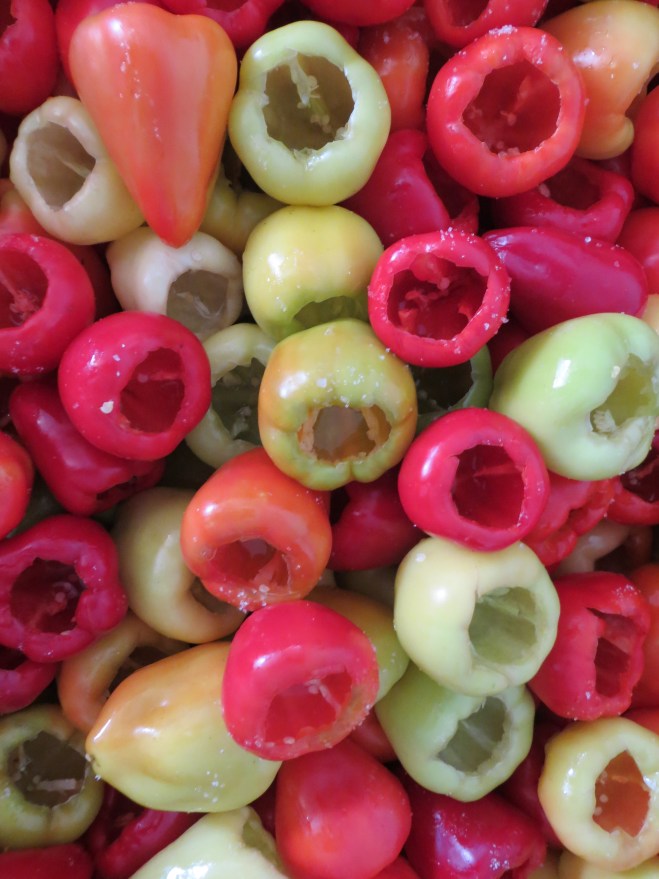
My host mother asked me if I’d like to accompany her to her sister’s house to see the canning process. We arrived at 11:30 a.m. and did not leave until 8:30 p.m. (I had been warned this would be an all-day affair.)

IMG_1494
Speca for days …
IMG_1495
There’s more where that came from …
IMG_1498
Speca! I mean, peppers


IMG_1517
Literally, my only contribution to the process
IMG_1520
In the future, there will never be a time when I am not eating speca.


Guest Blogger: Chelsea Coombes

Hi, everyone! My friend and fellow Peace Corps trainee, Chelsea Coombes, graciously agreed to write a guest post for my blog. (I figured you all might appreciate hearing a perspective other than mine!) Her post is below. — April

IMG_3430
April and Chelsea


I am extremely grateful to April for including me in her blog as a guest. I find myself constantly reading her posts. We all acknowledge that we have our single stories, however it is great to be going through this experience with such an inspiring new friend.

I had a very hard time choosing what I wanted to write about. I myself have not started a blog. I have been thinking how I would like to document my time here in Kosovo and I am not much of a blogger, but this is a good chance to try it out! While I was pondering what I wanted to write about I asked myself “what do you love most about Kosovo?” the answer, my host family.

I am a 24-year-old grad student who has only been out of her mother’s home for one year. I lived in Florida most of my life. Last year I moved to New Hampshire for school and at the time I thought that was the biggest decision of my life. That is of course until I moved thousands of miles away to Kosovo for Peace Corps. These last few months have been incredibly challenging, but extremely rewarding.

With that being said, I have never felt more included. The beginning of pre-service training (PST) is a blur, but I do remember meeting my PST family. Standing at the school with fear radiating through my entire body I was paired with the family who would take me in for the next three months. I have a host brother around age 20, two host sisters one who is the same age as me and one around 27, and a host mother. We awkwardly stared at each other and made small gestures while they helped me with my bags to their car and drove me to the house. Once at home we all sat around the table outside and the first thing they asked me, that I had to later translate was “do you feel at home?” I look back at this moment often. Here I am, miles away from my home and everything I know with a family whom I couldn’t communicate with in Albanian or English, and all I can think about is how generous they are. How they went out of their way to make me feel at home, even from day one.

Every day they make sure I am included in their family plans. I was invited to my host sister’s wedding the second day I arrived in country.

Their kindness and closeness has been overwhelmingly gracious. But it was a few weeks ago that really solidified my place in this family. It was storming and our power was out. I opened my door to find them settling down in the hall, the door was open and they had a flashlight. My host mom pulled up a cushion and encouraged me to sit. We ate chocolate, laughed about the rain and huddled up to each other. I felt like such an important member of a family, I felt loved.

PST is coming to a close and I know that the hardest part is going to be leaving them. My permanent site is about a 6-hour bus ride, and though I know I will visit it still feels like goodbye. I have seen my host mom sick, my sister leave for school to Germany, my host brother in goofy moments and my older sister become a wife. Being with a family through big transitions and being a part of them really makes you feel connected.

To the family that put up with my strange eating habits, laughed at my poor language skills and constantly let me know I was not a guest but part of this family, thank you.