Welcome!

Hello! My name is April. I am a social worker who served in the United States Peace Corps in Kosovo from June 2016 – July 2018. Welcome to my blog.

I have lots of useful information here, whether you are joining Peace Corps Kosovo, traveling to Kosovo, or just want to learn more about the Balkans.

If you are planning to serve in the Peace Corps in Kosovo, I have written a series of posts just for you. Search for the tag “newbie.” 🙂

Guest Blogger, Christian: I Choose to Stay

April’s note: The following guest blog post was written by my friend Christian, who is choosing to extend his Peace Corps service.

This week is our close-of-service conference, a reflecting period on our two years here and marking the final sprint of our 27-month service. In 60 days, most of my peers will pack up and begin returning home to new careers, new lives, and wish lists of missed foods. However, I elected to continue my service for a third year. I choose to stay.

Not everyone understands my reasons for staying, I think. After living and working in Kosovo for two years, I finally think that I am beginning to hit my stride. I’ve realized that this time has been a relatively short period to adjust and integrate into a new culture and where my weeks are still marked new discoveries. Extending my service will allow me to continue with my work which I feel is making an impact. Formally switching into the “Community Development” portfolio allowing me to work with several non-governmental organizations and Kosovo’s vibrant youth culture. There are dozens of organizations filled with young, progressive Kosovars that I would have the privilege and excitement to work with as they shape the future of their communities and their newborn country.

During my service, I’ve struggled with the strict gender roles that exist within my community. Being the only male volunteer placed within a village from our cohort, which I’ve had difficultly reconciling my struggles with these gender roles since I am cultural permitted so much more than female volunteers, but exist within the same paradigm. The village’s traditional gender roles which promotes anachronistic masculinity; manual labor, football, and objectification of women exists as the basis or preface of most conversations admist lingering cigarette smoke. This has always left me in a strained position because this is not me. I don’t typically do manual labor (though I’ve chopped wood with a teacher once before, much to my community’s delight), I’m bad at football, and cigarette smoke leaves me nauseated. This has left me feeling alienated when I don’t align with the male sphere and a more sensitive sphere is not an option. Though spared the strict cultural boundaries of a woman, inclusion in the permitting café culture promotes a natural separation. Familiarity always ends at the family home.

IMG-1804
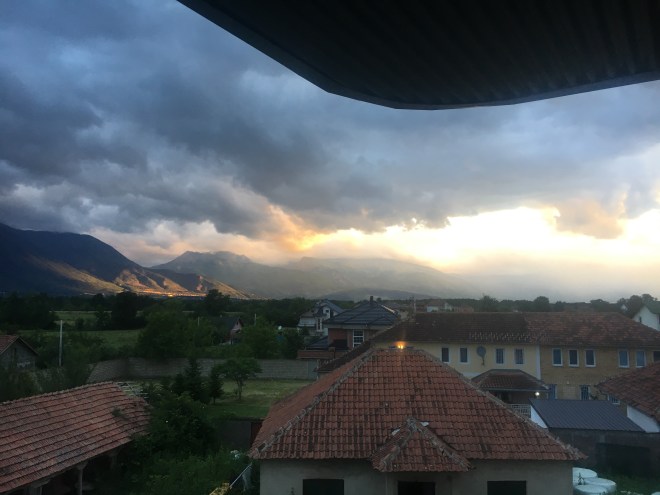
Christian’s village (Photo is courtesy of Christian)

I’ve tried addressing these challenges by working on learning the history of my village. My village was occupied by Serbian forces and sustained American bombing to dislodge them. Every summer, Halo Trust searches the various nondescript fields that comprise the village for the unwanted remnants of the war. Amenities such as water and electricity, everyday utilities that Americans and other developed world citizens take for granted, are relatively new to the village. Both of which were installed by USAID in an effort to rebuild the village and Kosovo in the post-war period. I have found my own solace with my difficulties by remembering theirs and their small, but significant gestures of showing me that I’m welcomed in their community, an honor that many wouldn’t receive.

Extending my service will require me to leave my quiet, farming village into the city of Peja. I adore Peja. I like the frequent rains and sipping makiatos by the soaked windows and walking between the scintillating trees and their ladel like leaves. Watching the fog banks roll down the mountains every morning and the blueish gray tones of the overcast skies melding with the light of Rugova Canyon. How the city exists almost in tandem with the nature around. The street dogs resting in sun lite patches through the parks’ canopy while the gyjshit nap on the benches, both in their usual spots. The gyjsha at the hole-in-the-wall pasta shop and how she slips between speaking Albanian and Dutch effortlessly, a skill she learned from husband who she met while studying cooking in Sardinia. Staying would let me become part of this dynamic rather than an observer.

One of my motivations for joining Peace Corps two short years ago was to experience something different. Initially I was offered or interviewed for several posts; Jordan, Armenia, Ukraine, before fate aligned with Kosovo. During our COS conference, I’ll reflect on my village and the conclusion of my tenure here. The surprisingly vivacious topic of whether I am a “Berisha” or a “Gashi” (both are local family names). The innate skill of knowing which cows belong to which family. Knowing where the spring puppies will be hiding, nestling into the wild grass for its generous reprieve from the heat (This is behind the mosque and next to the barbershop if you must know). The villagers giving me assorted squashes and gourds from the back of their tractors from their autumn harvests. And of my creative, selfie-eager students preparing for their final year exams, trips, and prom. I was motivated to experience something different and being a member of this community for the past two years was surely that.

Read posts by other guest bloggers:

Serving in the Peace Corps as an LGBTQ+ Volunteer

Note: This post is part of a series I am hosting on this blog to discuss challenges Peace Corps volunteers face while serving in Kosovo. The following post was written by an LGBTQ+ volunteer. — April

I am a volunteer of many identities – one of which being somewhere on the spectrum of LGBTQ+ – living in the EMA [Europe, Mediterranean, Asia] region of Peace Corps. Before I came to service, I was preparing my old home, back in “The Closet,” for a 2 year stay. I figured, “I’ve had to live there before. I can do it again, right?” Throughout the process (from applying to serving), I wasn’t sure who I would come out to or EVEN IF I would come out to anyone. I thought, maybe it would be best to not tell my interviewers or any staff that I was LGBTQ+, out of a slight worry that it would make me a less desirable candidate. Although, during my phone interview, I felt comfortable enough to be honest about how I identify. In hindsight, I am so glad that I did this, because it allowed me and the HQ/Post staff to be better prepared for my stay. I was able to openly ask questions about how my identity may create challenges for me, so that I could prepare myself – both in what information I would share with people and how I would share it. Post staff, knowing that at least one LGBTQ+ identifying member would be serving, took initiative to properly train their American and host country staff in Safe Zone practices.

Personally, almost as soon as I met my fellow cohort members at staging, I decided to come out to them. I felt good vibes from everyone I guess, or maybe I had just grown so comfortable in my rainbow skin to hide myself in a group of Americans. I would say that I was fortunate though that everyone was really cool about it. I also felt comfortable enough with the post staff to be open about my identity early on. I have not had any issues there either, so yay! Despite my run of luck, it could have very well bit me in the ass quickly. To my pleasant surprise, we had a Safe Zone session very early on at in-country training, addressing the serious effects that outing someone can have while living in a country where many people do not support the LGBTQ+ community. All that being said, I would just advise to use discretion. If you want to roll in like me and come in with your rainbow flag casually visible to your new Peace Corps fam (fellow volunteers and American/local staff), then you also need to be aware of the potential consequences. Oh, let me make note that I don’t actually have a rainbow flag here. I DEFINITELY left that back home. Ultimately, it is your choice of how “out” you will be and with who. Remember, although many people may accept you for all of your identities, many others may have negative reactions that may lead to ostracization, hate-speech, violence… and if things do threaten your safety, there is a high likelihood of a shorter service than you expected.

As I said before, I am out to my Peace Corps fam. Additionally, I am out to a few other expats, both from America and other countries; and a select few locals. Keep in mind, that other expats do not go through the same extensive cultural training as we do… so, again, DISCRETION.

I AM NOT out to my host families or anyone in my village, which is probably one of my biggest challenges through service. There are moments when I wish I could share that part of myself honestly with them, and moments when I almost feel I can. I often put off the urges to come out to locals, which has been a good tactic; because I later realize that maybe it would not have been a positive experience or would have done more harm than good. Still, I hope that someday I can come out to those I have grown closest to and maybe I can open their minds in this aspect; especially with my host family, particularly my host siblings, because one day I hope they will be able to visit me in America. By that time, I will likely (well HOPEFULLY) be in a serious relationship and living with my partner, and I would not want to hide that from them.

In the meanwhile, I have had to find ways to cope with the repeated suggestion that I find a nice local partner of the opposite gender. In the beginning, I would just uncomfortably laugh and say “maybe.” Then, it progressively became funnier as I thought to myself, “ohhhh man, you guys don’t even know how much of a non-possibility this is.” Then, it began to bother me… and I had to figure out a way to be okay with it. Sure, I could’ve made up a fake partner, but that would have been a heavy, elaborate lie to keep up for two years. So what did I do? I decided to look at it from a different perspective. I couldn’t look at it as though they were trying to push their heteronormative agenda onto me, but rather that they liked me so much that they want me to find a reason to stay longer or come back more often.

I cannot honor my LGBTQ+ part of my identity all the time, but I have found safe places where I can – places where I can let down my hetero-mask. My safe places have included literal physical spaces where I am isolated or in a controlled environment, virtual spaces where I can talk to people I am out to, and amongst allies or fellow LGBTQ+ people (American and local). I have also learned to appreciate other parts of my identity.

Coming into staging and orientation, I was required to make an identity web, which helps volunteers reflect on the ways that the world sees them and the ways that they see themselves. These identities can include everything from nationalities, ethnicity, and orientations to passions, hobbies, and other personality traits. This was helpful to look back on when I started to feel like I wasn’t being true to myself. I was able to reflect on the things that I had written down and remember that the LGBTQ+ part of me didn’t define who I am. I think this ended up being a challenge for me, because it was a major part of my identity for the few years prior. I had learned to embrace that part of myself and took a large role in LGBTQ+ leadership in my community.

Overall, I have found peace in this experience. Even though it’s been personally conflictual, I am grateful that it encouraged me to reflect and nurture other parts of my identity. Service has challenged me in ways that I never imagined. I tried not to come with any expectations, which is good in ways but also not; so if you are going to have an expectation, let it be the expectation of challenges ahead. Then, when you face those challenges, don’t forget to be patient with yourself and be prepared to explore methods to develop your resiliency. Patience and resiliency are both things you have to continually work on through service (and life), but they can help you have an amazing experience and grow exponentially.

Some Advice

• Social Media. Locals will try to friend you on social media. Make sure your privacy settings are appropriate. You may consider making secondary social media accounts that you only use abroad (be careful not to get caught). If you choose not to do this, be prepared to say why you don’t accept people’s friend requests. Try Googling yourself to see what shows up.
• Adjust the truth. Sometimes you can make small changes to old stories, like changing a pronoun, which allows you to still share memories with locals without outing yourself. Be careful of big, elaborate lies though.
• Code words. You never know who knows English around you, and in some places the LGBTQ+ terms are the same as in English. For example, “zebras,” referring to a person who identifies in the LGBTQ+ spectrum.
• Safe spaces and safe faces. Spaces can be physical, virtual, or mental. Faces, whether or not they are right in front of you or through a screen, can be comforting. Make sure that others understand the importance of not outing; and if you have a secondary social media account, be sure that they know which one to tag.
• Reflect on cultural context. As I mentioned in my personal experience, I had to explore where the locals were coming from when they were suggesting I marry someone from the country. This may help ease frustrations.

Specific to Kosovo

• The Kosovar constitution is very in favor of diverse identities, but it often does not translate into practice.
• Currently there are 2 NGOs that support the LGBTQ+ community in Kosovo.
• Kosovo had its 1st recognized Pride in October 2017.
• LGBTQ+ events do exist, but they are often under the radar.
• All Peace Corps Kosovo staff go through Safe Zone training.
• Peace Corps Kosovo has an LGBTQ+ & Ally volunteers support group. There is also a Peer Support & Diversity Network that promotes safe spaces within the Peace Corps Community.

Read about other challenges Peace Corps volunteers face:

Q & A About Serving in the Peace Corps in Kosovo

Hello! A potential new volunteer recently emailed me some questions about serving in Peace Corps Kosovo, so I thought I would use them to create a blog post. At the end, I also included a question that a friend recently asked me.

1) How safe do you feel in Kosovo? Fairly safe. Have you ever felt threatened or in danger? The two worst things that have happened to me are: 1) A student threw a rock at me as I was crossing the school yard, and it hit me on the back of my shoulder. Three students were suspended for a week as a result, and I no longer teach their classes. 2) I was taking a walk one morning, rounded a bend in the road, and came upon a large, angry stray dog. It approached me several times and barked at me, but it eventually moved on. I would say I find environmental concerns (stray dogs, lack of seat belts in cars, lack of adequate nutrition and exercise, and exposure to second-hand smoke and air pollution) more worrisome than my experiences with people here. I mostly feel safe around Kosovar people. Do you think a self defense class would be a good idea? I think taking a self defense class is always a good idea, and is something every woman should do.

2) How hot and cold does it really get there? I am from the Midwest, and weather in Kosovo is like the weather in the Midwest. It gets very hot in the summer and very cold in the winter. A major factor here is that central heat and central air conditioning are rare to nonexistent. Do I need to bring a long down jacket for winter? Yes, absolutely! Are the summers too hot for jeans and a T-shirt? I don’t wear jeans in the summer because it is too hot. I recommend wearing long skirts, linen pants, capri pants, etc. Some people wear shorts, but I would recommend dressing more conservatively here than you might in the United States.

3) Have you gotten placed next to any other Peace Corps volunteers? My first year here, I had two site mates. They didn’t live in my village but they were only a ten-minute drive away. They are both gone now. This year, I am alone at my site. The next-closest volunteer is probably an hour away from me by bus. However, I see other volunteers all the time in Pristina. Kosovo is small so I wanted to know if it is pretty standard to work at a school with other Peace Corps volunteers. Volunteers are never placed at the same school, even if they live in the same village.

4) Do you have daily access to fruits or vegetables? Mostly (kinda?) yes. My host family eats peppers almost daily. Sometimes, we also have cabbage or pickled vegetables. There is not much variety, however, in vegetables or in meals in general. If you are curious to know what I eat, you can read my 5-Day Food Diary. How much of a say do you have in your diet? Almost none. If I say that I would prefer to eat less of something (like sugar or bread), will the family take extreme offense to that? No, not at all, at least in my experience. I think it is important to be honest with your host family about what you will or will not eat. For example, I hate onion and my host family knows this. If my host mother makes something with onion in it, she will make me a smaller, separate portion with no onion.  Can I just buy my own food and cook my own meals? You will negotiate the meal situation with your host family and yes, some volunteers do cook their own meals.

5) How often is it considered appropriate to shower in Kosovo before it becomes rude (as in your host family gets irritated with you for using up amenities)? I shower and wash my hair every day. As far as toiletries go, I buy my own soap, shampoo, toothpaste, etc. Having good hygiene has always been important to me — it’s just a part of who I am. I compromise on plenty of stuff as a volunteer, but I am not willing to compromise on maintaining good hygiene.

I think volunteers (especially in the beginning of service) are really nervous about being seen as “weird” or doing something offensive, but remember, you will be a foreigner in Kosovo. You are bound to do things that are “weird” because you come from a different country with a different culture. You are not going to perfectly blend in. As long as you aren’t being deliberately disrespectful or offensive, do what makes you happy. Is [showering] every other day excessive? I don’t think so.

6) What has been the hardest cultural aspect for you to adjust to in Kosovo? All of it has been a huge adjustment. As far as the hardest thing, I would say that because Kosovo is a patriarchal society, experiencing the way women are thought of and treated has really been hard. I also hate all the smoking!

7) My friend Dana (hi, Dana!) recently asked me how many Americans are on staff here in Kosovo. All Peace Corps posts (meaning, host countries) have to have three Americans on staff: the Country Director, the Director of Programming and Training, and the Director of Management and Operations. All other staff members (administrative assistants, medical staff, IT director, accounts payable/receivable, program managers, small grants manager, supply chain manager, and drivers) are from Kosovo.

As always, I hope my answers are helpful! Thank you for reading.

Sexual Harassment in Kosovo

Note: This post is part of a series I am hosting on this blog to discuss challenges Peace Corps volunteers face while serving in Kosovo. Below, a friend of mine shares her experiences with sexual harassment. — April

Let me start off by saying that what I am about to talk about will show a more negative side to my time in Kosovo but that does not reflect my overall feelings towards my country of service. I’m still here, aren’t I? However, I would be lying if I said that it didn’t affect me, sometimes more so than I’m willing to admit. I can directly attribute my depression last September to the excessive amount of sexual harassment I experienced one day after another. While you’ll find different perspectives from volunteer to volunteer, many additional stories, what I write here is all from my personal experience.

Being a solo female traveler comes with added hardships that are out of my control simply because of my gender. Many of you females reading this will understand that simple statement. So if follows that being a female volunteer will also come with a lot of similar difficulties.

Kosovo, for all intents and purposes, is a male-dominated culture. I have been able to circumvent many things simply because of my “Americaness” but not without difficulty. While there is a café in my village, I cannot go unless I’m accompanied by a male. It took months before I was allowed to be out after dark on my own. I am expected to stop whatever it is I’m doing and stand for men when they entered a room and I am often defined by my marital status (or lack thereof).

At first I thought that it was simply because I was an American as to why I was attracting so much unwanted attention. But then I realized it didn’t matter if people thought I was an American or an Albanian woman, the treatment was the same.

It started small (or it felt that way in my mind). Men calling at me in the streets whenever I left the comforts of my village, men “casually” touching me as they walked past, or inviting themselves for what appeared as casual conversations. Then I noticed how it seemed to escalate. Not only would men call at me in the street but on more than one occasion they would then start to follow me, either silently or insensately shouting personal questions in my direction. The casual touching turned into hands sliding across my breasts or butt to walk past me. The unwanted invitations to chat turned into them stalking me on social media and messaging me over and over and over again where even blocking them didn’t deter their efforts. I had just about had it when a man who was sitting in the seat in front of me on the bus began starring directly at me through the seat crack and began masturbating.

Sometimes it can feel constant. Summer is when I felt the worst because (what I assume) more people are out and about and it’s also when I left my village more often. While back home in America, I am the first one to tell a man who invades my personal space off, I don’t have the cultural or linguistic knowledge here to do it. Honestly, I don’t know if I ever will. So I found myself staying in the confines of my small village to avoid the harassment but all that did was make me more depressed. It took all my will power but I wasn’t going to let these ignorant people ruin my life.

So while I know it still happens I’ve found some coping mechanisms that help to let it not impact my mental health so much.

1. Headphones. Honestly, what I think is the best invention since sliced bread. If I’m alone most likely my headphones are in. They don’t even have to be playing anything. Don’t get me wrong, this isn’t America and people will still try to talk to you but it gives you a full proof excuse to pretend like you don’t hear them even if you do.

2. I’m normally the type of person that is fully aware of all of my surroundings. However, I have pulled my scope in. Not too much that I compromise my own safety but enough that I don’t have to notice every disgusting comment, gesture, or look sent my way.

3. Being a regular. This can honestly go both ways, which is why it may take a few tries to get it right. I have a regular bus I take to the major cities with drivers and attendants who know me. I go to the same cafés every week with people who know me. They are the people who will look out for me when I need it. While I absolutely loathe feeling like a damsel in distress who needs others to protect me, I’ve sucked up my pride because it doesn’t hurt to have people in my corner.

4. Companionship. I have found that if I am just with 1 other person, especially another male, the sexual harassment dissipates if not becomes almost non-existent. Which is also why it can be very difficult for my male counterparts to understand exactly what it is that I experience on my own. While I may not recommend this as a permanent fix (because who wants to be escorted all their life), my service here is only 2 years so it’s a minor adjustment I’m willing to make.

Being sexually harassed is an exhausting experience. Sometimes I feel like I have to constantly look over my shoulder to protect my safety. Many friends have said that maybe I’m over exaggerating it or that I’m too defensive and should be nicer because they don’t mean any harm. But that’s just it. I don’t know. I don’t know who they are, what their intentions are. There is a thin line between harmless flirting and creepy stalking and I’ve found that it’s a line that many men here don’t know the difference between.

To my female readers, keep trekking on. Find the things you can do to make it easier on yourself. Don’t let male-dominated cultures or harassment make you give up.

Shades of Kosovo: Handling Racism as a Peace Corps Volunteer

Note: This is the first blog post in a series I plan to do on challenges that Peace Corps Volunteers face while serving in Kosovo. My friend and I chose to write this piece using a question-and-answer format. For privacy reasons, I am referring to my friend as “Guest Blogger.” — April

April: How often do you experience racism here in Kosovo?

Guest Blogger: On any given day, I can generally expect to receive at least a small handful of racial comments and taunts whenever I walk around my site, which is a small city of about 35,000, especially along the main road. Namely, in a large majority of cases, I’ll hear young boys and men between the ages of 10 and 30 say in Albanian, “Ohhhh, China!” “Chinese guy” or “Japanese guy,” and make fake Asian language sounds in my direction.

There’s an old guy who’ll pretend to do what he believes is kung fu whenever we cross paths every once in a while. Though such an action is so blatantly racist, I find it kind of amusing.

The taunts and remarks I hear with much greater frequency, on the other hand, are just outright offensive and tiresome. I’ll also have people ask me about whether I’m from China, Japan, or Korea with regularity. Though understandable, such a question never ceases to be irksome because I’ve heard it my entire waking life. I hate this part of my service, but I don’t know what else to do but accept and adapt.

I’m so grateful that I’ve never ever experienced any racism from those whom I’ve had to work with closely and live with. They’ve always offered me the utmost respect from the very beginning for who I am and what I do for them and their community. When they’ve judged me, they’ve judged me by my attitude, words, and actions, not my skin color.

April: If you are able to look at your experiences objectively, how much of what you experience would you say is outright malicious, versus people being curious about you and perhaps just expressing their curiosity in an annoying but non-malicious way?

Guest Blogger: I think it almost always the latter. Because Kosovo is so homogeneous racially, socially, and culturally, I realize that the people — overwhelmingly young men — who direct racist remarks at me do not know any better. In other words, they act improperly in the eyes of many because they haven’t had exposure to other races and cultures and any direct personal interactions with non-Albanians. They literally lack the knowledge. In fact, “racist” doesn’t have much meaning as an epithet here, and I think it’s fair to say many Kosovars would struggle to define race and diversity.

For instance, I bet those who make fake Asian sounds at me do so because they’ve seen Asian characters, or Asian-like characters, act a particular way on TV and in movies and automatically assume that all other Asians on this planet must talk and act the same way. Jackie Chan, in this regard, has been a blight on the depiction of Asian people and Asian culture in mainstream culture. Hence, I hear young comedians-in-training call me “Jackie” here and there as they pass me on the street. They think they’re tough and clever — and they’re not! They’re pathetic — and I do wish I could stop them in the middle of the street and deliver some grand lecture that will open their minds and change their behavior right then and there. However, such a thing is impossible.

I do not think people who act in such an irritatingly shallow way mean any harm. However, I still cringe and — depending on my mood at the moment — might even feel hurt and become pissed off whenever I hear such racial remarks. I feel hurt because racial taunters in Kosovo say the same things classmates and peers who picked on me because of my race said to me as I grew up in a predominantly white suburb in Northern New Jersey. I’d prefer to have not daily reminders of this aspect of my life in elementary school and middle school. I become pissed off because I believe, in light of their country’s recent history, all — and I do mean all — Kosovars should know much better than to judge people based on their race and ethnicity. You do not need to know English or to have studied abroad to have such a perspective.

Generally speaking, no matter where they are from, I believe people in this day and age where there is unlimited access to information and knowledge should know better than to judge others by their race and racial stereotypes. I feel it’s my solemn duty as a PCV working in local education to help Kosovo’s youth gain such knowledge and discover their own insights on diversity and multiculturalism that many of their peers in other countries know to be self-evident truths.

April: Is most of what you experience verbal? Have you ever felt physically threatened in Kosovo due to racism?

Guest Blogger: All of the racism I’ve experienced has been verbal. Kosovo is an exceptionally safe place, and I’ve never felt physically threatened or uncomfortable in any place at any point during my service. Still, living in a place where people will judge me on my appearance and act on what I suppose is an impulsive need to remind me how I look is unpleasant and unwelcoming. The community integration process is difficult enough in general for all PCVs and is compounded when they look so different from everyone else in the community. The people here take such pride in how welcoming they are, especially internationals. In some ways, I’ve never been treated better at any point in my life in any place and will likely never receive such hospitality outside of Kosovo. However, when this blissful bubble bursts after I hear a racist remark directed at me, I can’t help but wonder how welcoming they really are to all internationals, not just those who could pass as Albanian.

April: Would you feel comfortable sharing the worst instance of racism that you have experienced?

Guest Blogger: I can’t really say that I’ve had a “worst instance” of racism in Kosovo. I want to say that all of them are bad because racism is racism, no matter the intent. Still, it’s unreasonable for me to say that all instances of racism I’ve experienced are equally bad. Some Kosovars genuinely thought that they were speaking Chinese with me when said “ching chong chu” at me, and admitted that it was a misunderstanding on their part and begged for forgiveness of their ignorance. Also, if they really sought to be racist, they could’ve called me something much worse like “Chinaman,” “chink,” “gook,” “jap,” or “yellowman.”

Two instances still stick out to me. One time is an older waiter at a tea house slanted his eyes at me when I walked in the door. I wanted to berate him, but what I figured that such a reaction from me would achieve nothing positive. He doesn’t speak English, and my Albanian wasn’t good enough at the time to offer him a lesson on racial and cultural sensitivity.

Another time, another “tough guy,” which is a personal term I use to refer to young men who make racist remarks at me in passing but don’t own up to it when I confront them, at my school simply would not concede he was being racist when he said “ching chong chu chu chu…” at me and refused to apologize. I suppose he struggled to understand why I would become so upset with him. I found the refusals to acknowledge any wrongdoing and to apologize to be even more offensive than the racist remark. This case is still the only time — and I sure hope the last — where I’ve taken a student to my school director’s office for disciplinary action. Teaching at my school is difficult enough because of my students’ generally weak academic abilities and widespread disrespect for all teachers, and I was just not having it that day.

April: What are some strategies you have used to avoid experiencing, or confront, racism?

Guest Blogger: I simply actively choose to ignore racist remarks and carry on as if I heard nothing. I know that sometimes giving the taunters attention can make things worse because I am reacting the way they want me to. No action is, in fact, oftentimes the best course of action when I know I’m receiving racist taunts from people I don’t know, who likely do not know English, who likely wouldn’t understand me in Albanian, and whom I likely won’t see again anytime soon.

I generally have headphones in whenever I’m out and about in my town, which I find to be another effective avoidance technique. Nevertheless, I can still hear “tough guys” taunt me sometimes, either because they shout that loudly at me, or because I’ve become so attuned to racism that I can hear it over the music and podcasts I listen. Though not easy, I bite my lip, keep looking ahead, and continue on my way as if I heard nothing. I believe they simply want the attention and the satisfaction my attention brings them, so I’m not going to indulge them.

Whenever I feel I must respond, I simply shout “No!” back at them, wag my finger, and shake my head in disapproval as I walk away. They get the message, great! If not, oh well …

For those who have the language skills and willingness and openness to have a discussion about racial diversity and racism, I try to use their remarks as a teaching moment to explain how their words are, in fact, racist and why they are offensive and hurtful to me and many other people who look like me. To drive home the point and help them to feel the pain I feel when others mock me for being Asian, I’ll mention how the movie Taken depicts Albanians extremely negatively and ask them how they would feel if I assumed all Albanians are criminals based on this one well-known cultural depiction of Albanians. No one likes to be pigeonholed in such a way. I have found establishing such common ground on negatives leads to positive and enlightening discussions about our worldviews on both sides.

April: Why do you think some people in Kosovo say and/or do racist things?

Guest Blogger: To reiterate what I said earlier, I think some people in Kosovo make racist remarks because they do not know any better. They might not even know what racism is, and, therefore, would not feel badly if called racist. I want to emphasize that I do not think they should receive much blame, if any, for acting insensitively because of Kosovo’s homogeneity and isolation from the rest of the world. They haven’t learned before and interacting with a person of color is a golden opportunity to take a first step in the learning process.

April: What advice would you give to someone who isn’t (or doesn’t look) Caucasian and is considering serving in Peace Corps Kosovo?

Guest Blogger: I have a couple of suggestions:

1) Please pardon the puns: I advise finding your own ways to grow a thicker skin when confronted with racism and other comments and questions about your identity. The less you allow racism to get under your skin, the less stress you’ll create for yourself — generally speaking. In these cases, sometimes no action is the best action.

2) Even if you become resistant to, grow to tolerate, or even come to accept racism as a part of your everyday life, it doesn’t mean you should desensitize yourself to racism and let everything go. In my experience, I can allow 99 racist comments and taunts to slide, but then the 100th can just set me off for reasons I still struggle to understand when I look back at moments when I blew up.

I can’t say that I’ve always responded gracefully and thoughtfully to racism. When I’ve allowed my sensitivity to racism to overwhelm me, I believe I actually made the incident worse than it needed to be. More often than not, it was a case of misunderstanding on both sides. Taking a second to breathe and calm down when feeling the urge to react has helped me maintain a mental balance when I know that I have this kind of daily struggle with myself and others each and every day.

3) I cannot emphasize this enough: Try to imagine how different — and even strange — it must be for the average Kosovar to see a non-white person in their community. Outside of Prishtina and Prizren (the two largest cities in Kosovo), it’s rather uncommon for Kosovars to see people of color in their communities. I advise being empathetic to the fact that they often simply do not know how to act around non-Albanians because of their lack of firsthand exposure to different cultures and people. They’re curious and mean well. They just don’t know how to respond — yet!

4) I say yet because I’d encourage PCVs of color to use instances of racism to inform when you deem appropriate. Trust your instincts when you choose to engage others in response to racism. Something as simple as “No, I’m American” has completely changed the way others who’ve never seen me before and don’t know who I am see me. It is awfully satisfying to see them respond so positively when I tell them I’m American. Other times, I just get blank stares or expressions of disbelief. I’ve even had people flat out refuse to believe I’m American, even after I’ve shown them my passport and other forms of ID. You won’t be able to convince everyone that you’re American and that many Americans aren’t white. You’ll go crazy if you try to change everyone’s perspective. Instead, give yourself a pat on the back when you’re able, in fact, able to change even just a couple of people’s outlook on the United States in a small but undoubtedly profound way.

5) Stand your ground when others try to tell you something different about your own identity that you disagree with. Being born an American is the best thing that’s ever happened to me, so I relentlessly push back against those who’ve told me that there’s no way I’m actually American because I’m Asian. I’ve told others in Kosovo, in other countries, and even in America that I want nothing to do with them ever again because I find their refusal to accept my Americanness to be gravely insulting. Take pride in your Americanness and never let anyone tell you otherwise if you feel similarly about your nationality.

6) Perhaps most important, laugh at racism. If you take racist remarks too seriously and can’t find humor in them, then you might well do more harm to yourself than any instances of racism ever can. I believe that those with malicious intent will feel disempowered and that those who express curiosity insensitively and ungracefully will understand that they’ve something wrong more clearly. Humor can be a great uniter and method of clearing the air. Also, finding humor will make your Peace Corps experiences all the more enjoyable and enriching in other ways those of “typical Volunteers” are not. I believe Peace Corps stories are the most memorable for good reasons.

Guest Blogger, Linnea Neuber: Expect Nothing and Appreciate Everything

Hey, guys! I am happy to share a post from guest blogger Linnea Neuber. Linnea is the first person from the Kosovo 4 cohort I have asked to write for this blog (all my other guest bloggers have been from my cohort, group 3, or the previous cohort, group 2). I like inviting guest bloggers to post because they offer a perspective different from my own. Since Linnea is new to Kosovo (well, newer than me. I’m still new, too!), I thought she might have some interesting things to share. 🙂  -April

23134719_10156912414779012_1934261240_o
Linnea Neuber

When April contacted me to write a guest blog for her, I initially felt hesitant. I thought to myself, “Your ability to write is maybe 3rd grade level at best,” but the idea of contributing to such a rich and informative blog intrigued me. I’m new here (to Kosovo, not to the planet) and I really appreciate April’s interest in expanding the seasoned perspective of her blog. Being part of the “New Kid Crowd” means that I have a fresh, wide-eyed and slightly bushy tailed take on this experience. (Mostly because I have yet to experience a winter here in the Balkans, so please, everyone cross your fingers for me.)

The Peace Corps is an interesting concept. Americans are dropped down into host countries, given a bit of training and then let loose (much like Girl Scouts once they’ve been given the go ahead to sell cookies door-to-door.) We’ve left our entire lives behind (we’ve sold cars, quit jobs, left apartments and packed up everything we own into 2 or more suitcases) and now find ourselves in the shocking situation of integrating into a new culture while speaking a broken form of whatever language we are learning.

And let me tell ya, it’s hard out here.

Personally, I find myself regressing back into a state of childhood. I’ve now become more forgetful (though I always lost my phone before, I now lose it at least 25% more throughout the day. I’ve made a pie chart.) I also find that I can’t work simple machines, such as microwaves, or knives, properly anymore.  And my shoes never stay tied. The English language is much more difficult for me to navigate. I have trouble recalling words that have more than 3 syllables (honestly, just now, I couldn’t remember the word “syllable”).

I love this experience but everyday is a struggle just to live and sometimes I’m not sure if I’m going to make it. I have 22 months left of me trying to figure out how to work different shower heads and sometimes I just don’t know if I have the strength.

However, there are lights at the end of this seemingly never-ending, fun house tunnel. One of these lights is my cohort, the fourth Peace Corps Kosovo group, KOS 4. 150 days ago we boarded a plane to Kosovo after meeting just two days before, in Philadelphia, where we bonded like a chemical reaction over delicious food and cliché icebreakers. They are my anchors in this ever-changing tide.

Other lights include my host family, my counterpart, and my new found friends at site that praise me for speaking even a little Albanian and who help me navigate my new home. Any time I feel down, I think of all the children in my classes who clap for me when I walk in to teach, or who laugh when I make jokes in English even if they don’t understand them (like the true saints they are.)

The truth about the Peace Corps is that it’s difficult, mentally and emotionally exhausting work.  Any expectations that I had 5 months ago have been completely blown away. A tornado has whipped through my life and left me in a little house with red shoes under it. I’m an entirely different version of myself, complete with Technicolor. And increasingly everyday, I’m optimistic that this yellow brick road ahead of me will take me to great places, complete with knowledge of a thousand different shower heads.

Read posts by other guest bloggers:

A Headache and a Half, or, The Story of My Grant Project

“I just get on the mic and spit it.” — Eminem 

I try to avoid talking about the Peace Corps as an entity on this blog. Technically, they’re my employer (or sponsor? over-seeing body?), and writing publicly about an employer is probably not a wise move. In all honesty, I have had a decent experience in my dealings with the Peace Corps. However, my grant project has been nothing but a headache from start to … haven’t finished it yet.

Peace Corps has a pool of money intended to fund grant proposals made by volunteers. To get funding, volunteers must write a formal proposal, submit it before the grant cycle deadline, and have it approved by the small-grants committee. I don’t know how this committee is structured in other host countries, but in Kosovo, the small-grants committee consists of selected volunteers and is overseen by Peace Corps staff.

My grant proposal was for about 1,600 Euro to buy sports equipment for my school. This proposal had been started by my site’s previous volunteer, but due to banking issues, never came to fruition.

After talking with my school, I decided to re-submit the project. I tweaked the original grant proposal and submitted it before the March deadline. I expected this process to be easy, since the project had received prior approval.

The months following turned into a quagmire. The small-grants committee would send me requested changes, I would make them and re-submit them, and then the committee would think of something new to change. After something like the 6th draft, I wrote an email to Peace Corps staff. I was professional in my email, but the gist was basically, “What the hell is going on?” I said that I would be willing to submit one more draft, but if the committee had changes after that point, I was going to drop the project.

A staff member offered to sit down with my grant adviser and me, and we hashed out the last round of changes. This was in May. Finally, my grant received approval.

Next, my counterpart and I had to set up a joint bank account. This process was also a bit of a quagmire. We had to go to the bank on two separate occasions. My host father had to come and sign a document stating that I live in his house. Then, the bank wasn’t satisfied with that document, so my host father had to go to the bank again and sign another document.

I then received word that the grant money would first be deposited in my individual bank account. I did not consent to this. The whole point of setting up a joint bank account is to add a shield from liability for the volunteer. But by the time I received word of this unsettling development, the money had already been wired.

Once the money landed in my account, I tried to transfer it into the joint account. It turns out, the joint account hadn’t been activated. The banker who helped us set it up had gone on a two-week vacation. I don’t know if this caused the delay or was just a coincidence, but in any case, it took another two weeks for the joint account to open. Then, I had to go back to the my bank to schedule another transfer.

When my counterpart and I went to withdraw our money from the joint account, she didn’t have to sign anything. I am not sure what happened there, if she is actually on the account or not, but I have concluded that banks in Kosovo don’t understand what a joint bank account is.

Anyway, this process has been tedious. I have follow-up paperwork to do in the months ahead. I am just glad my school finally got their sports equipment, after nearly two years of waiting.

gym at a school in Kosovo
This is the “gym” at my school, just a classroom.
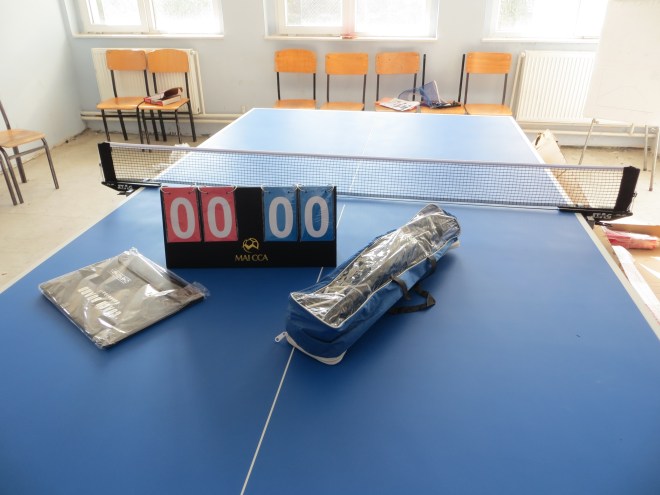
gym equipment storage
New equipment
setting up soccer football net 2.JPG
Physical education teacher
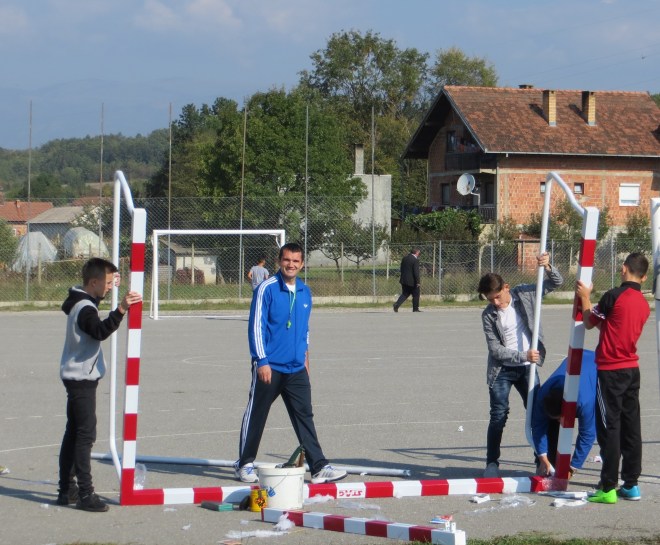
setting up soccer football net.JPG
Setting up the soccer/football goal
soccer football in Kosovo.JPG
Soccer
volleyball in kosovo.JPG
Volleyball

I was talking to another volunteer and we agreed — a grant project is an easy thing to point to when people ask what you did in the Peace Corps. It is much harder to quantify relationships you’ve built or the impact you’ve had on students, but in the long run, those things are far more important.

I also feel like, as “the American,” I get a lot of credit from the school and community for bringing this project about. But, I share the credit with many people:

  • Our physical education teacher, who was the catalyst for the project
  • The volunteer at my site before me, who started the project
  • My counterpart, for being a huge champion for the project. Also, since she speaks both Albanian and English, she often got stuck with the role of translator.
  • My project adviser
  • The small-grants committee. Even though I hated working with them, the project wouldn’t have been funded without their approval.
  • The local municipality, who gave us an additional 250 Euro for funding
  • The store where we bought the equipment, for giving us a 20-percent discount on our entire purchase
  • My host father, for going to the bank twice
  • The students and other teachers, who helped set up the new equipment
  • Our school director, who allowed us to host a “Day of Health”
  • the Peace Corps itself

Well, now I can add “grant writing” to my resume, even though it is something I never want to do again.

My Thoughts About “the Posh Corps”

The newest cohort of Kosovo Peace Corps volunteers recently swore in. I’ve slowly been getting to know them. Over dinner, someone asked me what I think of the term “the posh corps.” It was a thought-provoking question.

“Posh corps” is a term that’s been used to describe what serving in the Peace Corps is like today. I have mixed feelings about the term.

Several members of my best friend’s family served in the Peace Corps back in the 1960s, when Peace Corps had just begun. The stories they’ve shared with me are pretty hardcore. My BFF’s aunt served in the Philippines, and was only able to call home on Christmas, because phone calls were expensive. My BFF’s uncle used to walk 25 miles to work every day. I compare those experiences with my service in the Peace Corps now — I live in a house with wifi, which allows me to post regular blog posts. Thanks to modern technology, I am able to call, email, and message my friends and family whenever I want to. Letters and postcards are novelties, rather than sole means of communication. And I don’t have to walk 25 miles to get anywhere.

I don’t know what service is like in every Peace Corps host country, but as technology continues to evolve, I would imagine life in all PC countries continues to evolve, too. As a result, I would imagine that today, even volunteers serving in locations more remote than Kosovo are having much different experiences than volunteers who served in those same places fifty years ago.

So yes, I will say, life in the Peace Corps is more posh now than it has ever been. Add to this that I chose to serve in Eastern Europe. I live in a house with wifi, running water, and central heating (though, central heating is a rare luxury in Kosovo).

But on the flip side of things, I think referring to the Peace Corps as “the posh corps” dismisses the service of volunteers. No matter how evolved technology becomes, serving in the Peace Corps will be difficult. Leaving behind a familiar life experience to move to a foreign country, learn a new language, and live in a new place is stressful. Constantly having to adapt behavior is tiresome. Being seen as an “other,” even if it is a positive other (Americans are typically highly regarded in Kosovo), can be anxiety provoking on a daily basis.

Unless technology advances to the point where Peace Corps volunteers can spend the day working in their host country and then “beam home” at night, it will never totally eradicate the psychological difficulties of service.

I had a good life back home, one I did not have to leave. I chose to leave it, because I thought it was the right thing to do. Joining the Peace Corps was not a decision I made lightly. Based on research, I chose the experience I thought I could best handle. I didn’t sign up to serve in an African country (hot weather = no) because I knew I would likely quit. I couldn’t see the point in setting myself up for failure.

For me, the purpose of my service really hits home whenever I walk into one of my schools. My classrooms are equipped with only chairs and tables and a chalkboard, nothing else. Some of those chairs and tables are badly broken, yet students still use them because there is nothing else to use. Half of my students didn’t have textbooks last year. (Forget about studying or doing homework … how could they, without a textbook?) Rooms are poorly heated in the winter, and teachers and students alike stay bundled in winter coats and boots all day. The school day is divided in half (mornings for older students, afternoons for younger students), because there isn’t enough money to expand schools or pay teachers for longer days. That means students in Kosovo receive half as much education as students in Western Europe or the United States. In fact, Kosovo has been assessed as having one of the world’s worst education systems.

Every time I walk into one of my schools, I know why I am in Kosovo. I may have more “creature comforts” than Peace Corps volunteers in the past, or Peace Corps volunteers serving in more remote locations. But that does not mean Peace Corps service is not needed in Kosovo.

If you think serving in the Peace Corps sounds easy, I would offer you a smile and say, “Try it.”

Friday Gratitude: Anibar Animation Festival

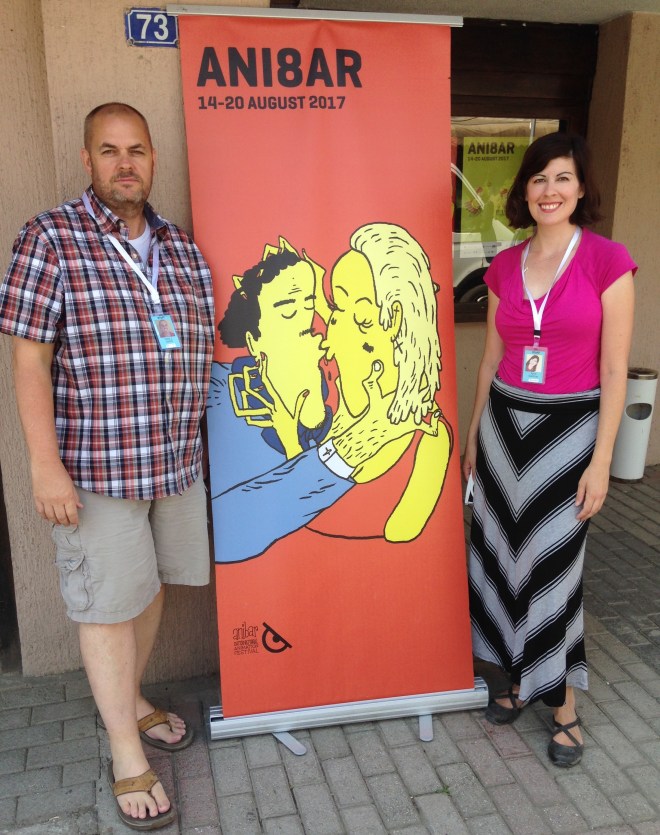
August 14-20 was the best week I’ve had in Kosovo. HANDS DOWN! I volunteered at the Anibar Animation Festival in Peja, Kosovo.

The Anibar Animation Festival began eight years ago. It was founded by my friend’s counterpart, when he was only 17. (What was I doing at age 17? Certainly not founding international film festivals.)

My friend had asked me if I would be the festival’s Jury Coordinator. I told him I would think about it. The next thing I knew, I was having a meeting with his counterpart, where we discussed my role as the Jury Coordinator. I walked out of the meeting thinking, “Wait! Did I ever … agree … to be the Jury Coordinator?”

Anibar Film Festival Peja Kosovo 1.jpg
It was the end of the week, and we were still smiling …

I’m not going to lie, I was dreading the whole thing. I pictured a bunch of high-powered Hollywood types who would call me in the middle of the night to make strange demands. Turns out, I was wrong to be so worried.

The jury was comprised of five lovely people who came from Spain, Switzerland, Poland, the Netherlands, and the United States.

2017 Jury Anibar Peja Kosovo.JPG

I met many new people from all over the world. At one point, I was at lunch, and all four of us spoke different native languages (French, Chinese, English, and Albanian). I love that my native language is the one used to facilitate communication between people who speak other languages.

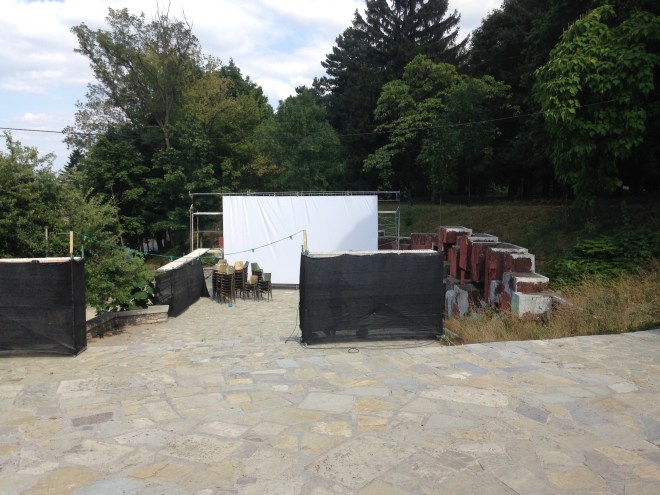
I also saw many films. The festival had two theaters, plus two screens they set up in a local park.

Anibar Animation Festival

Anibar Peja Kosovo

I loved some films, and hated others. Below are two of my favorite films shorts that were shown at the festival. (Warning: Don’t watch these if your boss or your kids are in the room!)

https://www.youtube.com/watch?v=iw_YdH7xWH8

https://www.youtube.com/watch?v=zW-RyxC10lo

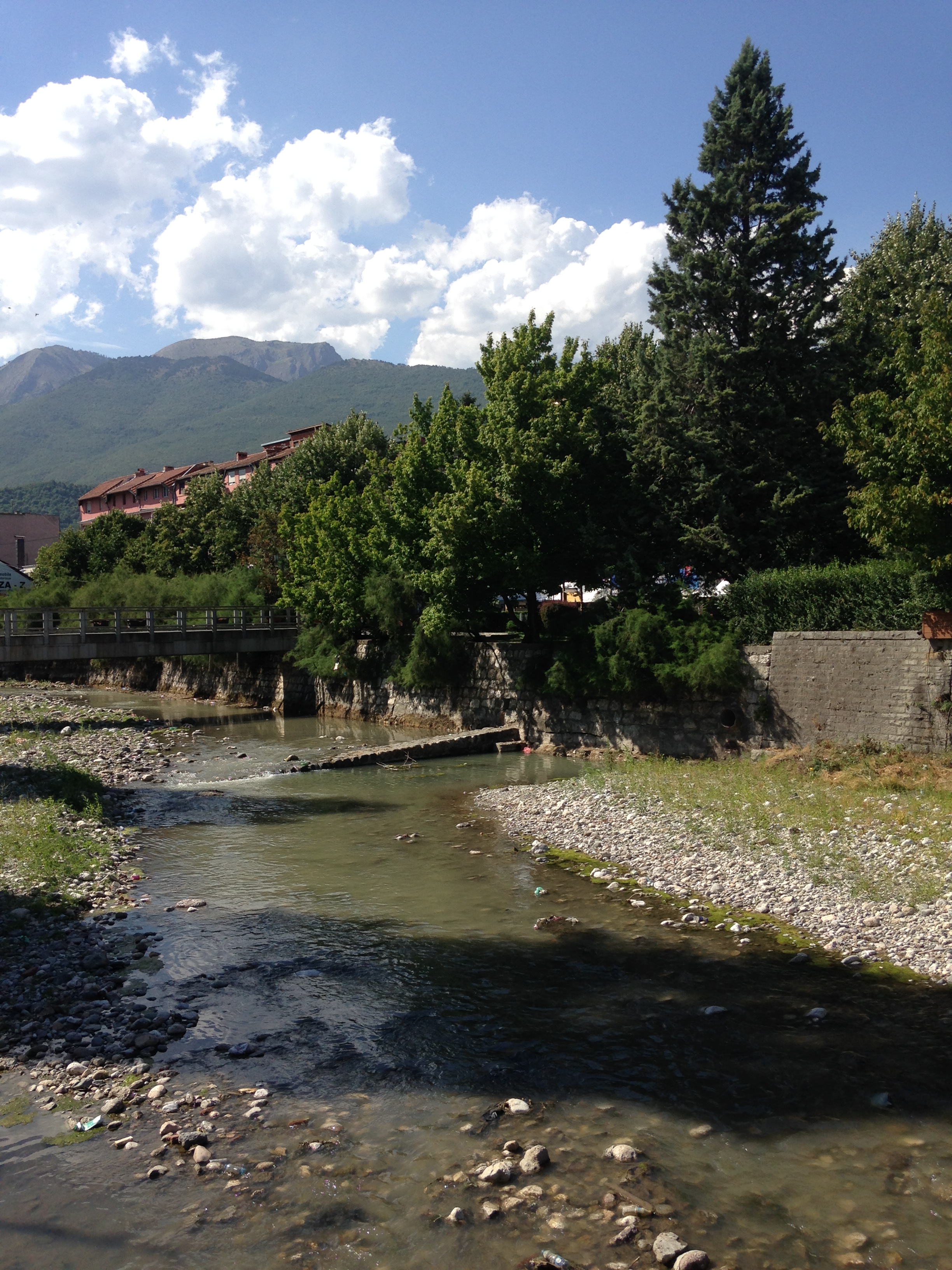
Volunteering at the Anibar Animation Festival also meant I got to spend time in Peja, which is my favorite city in Kosovo. I mean, would you look at this view?

Peja Kosovo.JPG

Even the weather cooperated, by backing away from the 100-degree mark.

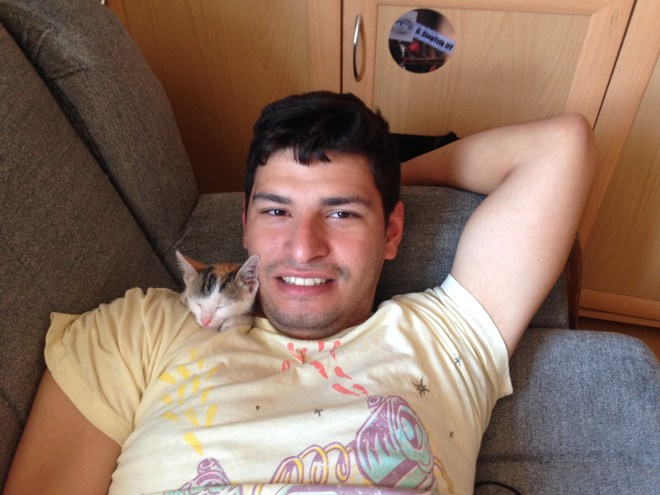
I miss the little routine I developed every morning, where I bought iced coffee (!!!) and went to the Anibar theater to hang out with my friends (and the newly rescued theater kitten) before the start of the festival’s daily activities.

theater kitten.JPG

It was a week full of friends, film screenings, workshops, talks, a gallery opening, and free food and drinks.

Puppet Anibar.JPG

The pouring rain on the night of the closing ceremony forced people to abandon the after-party at the park and stay at the theater. Group karaoke broke out across the theater’s stage and balcony. The night ended with a group of people dancing in the flooded streets of Peja.

Yeah, it was my best week in Kosovo …

Anibar
Thanks to Todd and Stephanee for this pic. 🙂